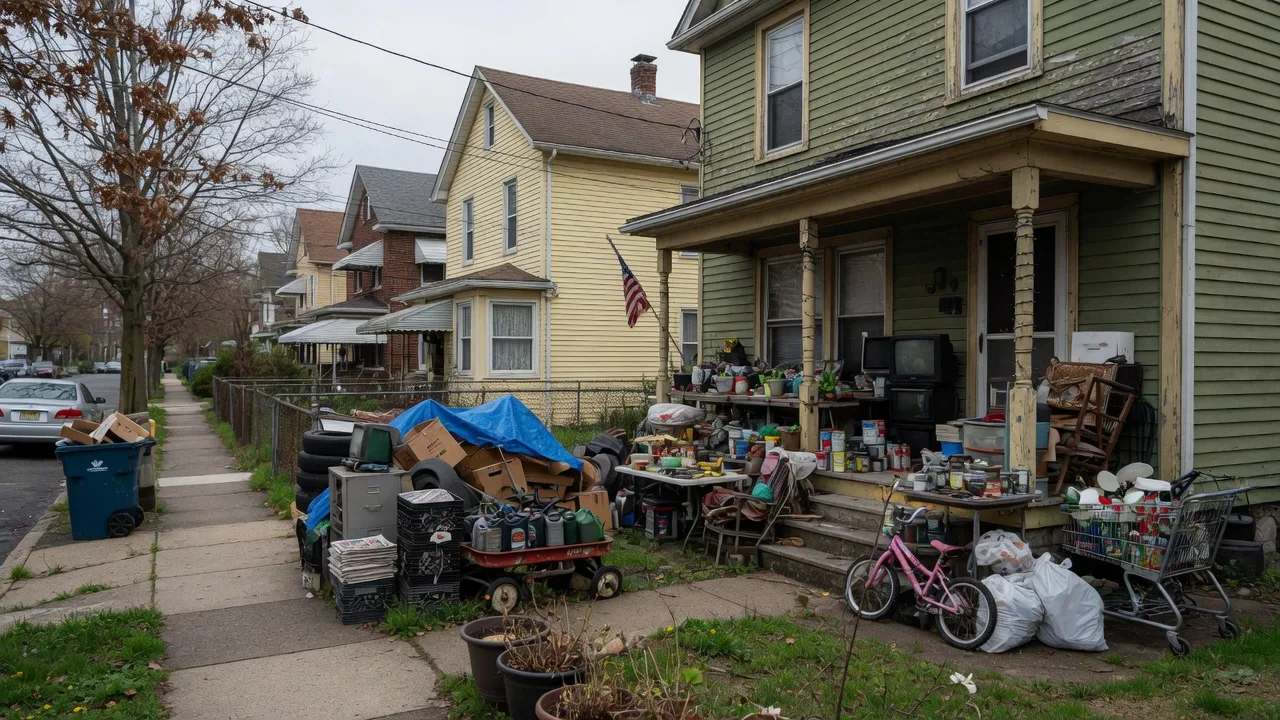
When a loved one passes away and the inherited property turns out to be a hoarder house, the challenge of settling the estate can feel insurmountable. Hoarding is more common than many families realize, and in North Jersey, where housing stock ranges from early 1900s row homes to mid-century single-family houses, estates with significant clutter and accumulated belongings frequently end up in probate. If you are an executor or heir dealing with a hoarder house in Passaic or Bergen County, this guide walks you through every step: the legal requirements for selling through probate court in New Jersey, how to handle a massive cleanout, disclosure obligations, and whether to sell as-is or invest in cleanup before listing. The goal is to give you a clear, practical roadmap so you can make informed decisions during an incredibly difficult time.
Why hoarder houses frequently end up in probate.
Hoarding disorder affects an estimated 2 to 6 percent of the adult population, according to the American Psychiatric Association. For families, the practical reality is that hoarding behaviors often worsen with age, illness, or isolation, conditions that frequently accompany the final years of a homeowner's life. When that homeowner passes away, the family is left with a property that may be packed floor-to-ceiling with personal belongings, accumulated items, and in some cases, debris that has built up over decades.
Several factors make hoarder houses especially likely to end up in probate rather than being transferred through other means:
The homeowner often lived alone or had limited outside help. Hoarding behaviors tend to isolate individuals. When there is no co-owner, spouse, or joint tenant to inherit the property automatically through rights of survivorship, the estate must go through probate to transfer title, even if there is a will naming a specific heir.
The property may not have been maintained or updated for years. In many cases, the home has significant deferred maintenance alongside the hoarding situation. Outdated wiring, plumbing issues, roof damage, and code violations accumulate alongside the personal property. By the time the family discovers the full extent of the condition, probate is often the only path forward.
Financial resources may be limited. Hoarding situations often involve financial stress. The estate may not have liquid assets to fund repairs or even basic cleanup, making the probate process and eventual as-is sale the most practical option for resolving the property.
In Passaic and Bergen Counties, where many homes were built between 1920 and 1960, hoarder estates frequently also involve older construction materials that add complexity, lead paint, knob-and-tube wiring, aging plumbing, and in some cases, structural concerns from years of accumulated weight and neglect.
Legal steps to sell a hoarder property through probate court in NJ.
Selling a hoarder house through probate follows the same fundamental legal process as any probate real estate sale in New Jersey, but the added condition of the property creates additional considerations at nearly every step. Here is the process from start to finish:
Step 1: File with the Surrogate's Court
The executor files the will (or a petition for administration if there is no will) with the county Surrogate's Court. In Passaic County, this is handled at 632 Hamilton Avenue in Paterson. In Bergen County, the Surrogate's Court is at 1 Main Street in Hackensack. The filing includes a certified copy of the death certificate, the original will, and the petition for probate. The court reviews the filing and, if everything is in order, appoints the executor and issues Letters Testamentary, the legal document that grants authority to manage and sell estate assets.
Step 2: Secure and assess the property
Once the executor has legal authority, the first priority is securing the property. Hoarder houses often have compromised locks, broken windows, or open entry points that make them vulnerable to trespassing, theft, or weather damage. The executor should change locks, board any broken windows, and ensure the property is safe to enter. Insurance should be reviewed immediately, a standard homeowner's policy may not cover a vacant or cluttered property, and a specialty policy may be needed during the probate period.
A visual assessment should be conducted to understand the scope of the hoarding situation and any obvious structural or safety concerns. This assessment does not need to be a formal inspection at this stage, it is about understanding what you are dealing with so you can plan the next steps.
Step 3: Handle the cleanout (if needed)
The cleanout of a hoarder house is often the most daunting part of the process, and it is covered in detail in the next section. The key legal point is that the executor has a fiduciary duty to the estate, which means any items of value found during the cleanout must be inventoried and accounted for. Items that may have monetary or sentimental value, jewelry, collectibles, cash, important documents, should be set aside and documented before general cleanout begins.
Step 4: Disclose the property condition
New Jersey has specific disclosure requirements for residential real estate sales. The seller must complete a property condition disclosure statement or provide a $500 credit to the buyer at closing in lieu of the disclosure. For hoarder houses, the disclosure must accurately reflect the condition of the property, including known issues with structural integrity, plumbing, electrical systems, environmental hazards, and any code violations. The fact that the property was a hoarder house is a material condition that should be disclosed.
Step 5: Price the property and list it
Pricing a hoarder house requires careful consideration. A probate-certified agent will evaluate the property's as-is condition, comparable sales in the area, the lot value, and the potential after-renovation value to determine a price that attracts qualified buyers. For hoarder houses, this often means pricing for the investor and renovation buyer pool, since traditional financing may not be available for properties in severe condition.
Step 6: Obtain the inheritance tax waiver and close
Before closing, the executor must obtain a tax waiver from the New Jersey Division of Taxation. Processing typically takes four to twelve weeks. Once the waiver is received, the sale can close. The proceeds are used to pay estate debts, taxes, and administrative costs, with the remainder distributed to the beneficiaries.
How to handle the cleanout.
The cleanout of a hoarder house is a significant undertaking that requires planning, patience, and often professional help. Here is a practical approach that balances thoroughness with cost efficiency:
Inventory valuable items first
Before any general cleanout begins, the executor (or a designated family member) should walk through the property and identify items of potential value. This includes financial documents, insurance policies, deeds, jewelry, collectibles, artwork, antiques, cash, and anything with documented provenance. These items should be photographed, cataloged, and secured separately. In New Jersey, the executor has a fiduciary duty to preserve estate assets, and skipping this step can create liability.
Hire a professional cleanout service
For most hoarder houses, a professional cleanout company is essential. These companies specialize in removing large volumes of property efficiently and responsibly. In the North Jersey area, several companies handle estate cleanouts specifically. Costs typically range from $2,000 to $10,000 or more depending on the volume of items, the size of the property, and whether hazardous materials are present. Some cleanout companies offer estate-specific services that include sorting for valuables, donation of usable items, and proper disposal of debris.
When selecting a cleanout company, verify that they are licensed and insured, provide a written estimate before starting work, have experience with estate and probate cleanouts, and can provide a certificate of disposal for the items removed. Some companies will offer a flat fee; others charge by the volume or by the truckload. Get at least two to three quotes before committing.
Address hazardous materials
Hoarder houses may contain hazardous materials that require special handling. These include mold (which thrives in cluttered, poorly ventilated spaces), accumulated chemicals or cleaning products, animal waste in cases where pets were present, and in older North Jersey homes, lead paint dust that may be disturbed during cleanout. A professional cleanout company should be able to identify and properly handle these materials, or refer you to a specialist if needed.
Document everything
The executor should photograph the property before, during, and after the cleanout. This documentation serves multiple purposes: it provides evidence of the property's condition for disclosure purposes, it supports the estate's accounting of expenses, and it can be useful if any disputes arise among heirs about the handling of estate assets.
Disclosure requirements for hoarder houses.
New Jersey law requires sellers of residential real estate to provide buyers with a property condition disclosure statement (N.J.S.A. 46:3C-10). This disclosure covers the property's structural condition, mechanical systems, environmental hazards, and any known defects. Alternatively, the seller may elect to provide a $500 credit to the buyer at closing in lieu of completing the disclosure form.
For hoarder houses, disclosure is particularly important for several reasons:
The hoarding condition itself is a material fact. Even after a cleanout, a property that has been subject to long-term hoarding may have damage that is not immediately visible, floor damage from the weight of accumulated items, wall damage from moisture or pests, compromised ventilation, and hidden mold or mildew. All of these conditions should be disclosed.
Known code violations must be disclosed. Hoarder houses frequently have open code violations with the local municipality, including fire safety violations, sanitation issues, or building code non-compliance. These must be disclosed to potential buyers.
Environmental concerns require attention. In older North Jersey homes, particularly those built before 1978, lead paint is a concern that is exacerbated by the conditions in a hoarder house. Peeling paint, accumulated dust, and disturbed surfaces can all increase lead exposure risk. This should be disclosed, and buyers should be informed of the property's age and the potential for lead-based paint.
Failing to disclose known conditions can expose the estate to legal liability after the sale closes. A probate-certified agent will help ensure that the disclosure is complete and accurate, protecting both the estate and the executor.
Sell as-is or invest in cleanup first.
One of the most common questions families face with a hoarder house is whether to sell the property as-is or invest money and time into cleanup and basic repairs before listing. The answer depends on the estate's financial situation, the property's underlying condition, and the family's timeline. Here is how to think through the decision:
When selling as-is makes the most sense
Selling as-is is generally the right choice when the property has significant underlying issues beyond the hoarding (structural damage, major mechanical failures, extensive mold), when the estate has no liquid funds to pay for cleanup, when multiple heirs need a quick resolution, or when the cost of cleanup would not be recovered in a higher sale price. In many hoarder house situations, the as-is investor market is the most practical path. Cash buyers who specialize in renovation properties are accustomed to purchasing homes in all conditions, and they close quickly, often in 30 days or less. For executors who want to minimize stress and management responsibilities, an as-is sale provides certainty and speed.
In Passaic and Bergen Counties, investor demand for renovation-ready properties remains strong. Municipalities like Paterson, Passaic, Garfield, and Hackensack all have active investor markets where properties in severe condition regularly sell. An experienced probate agent knows which investors are reliable, what they will pay, and how to structure the transaction to protect the estate.
When cleanup before listing may be worthwhile
If the underlying structure of the property is sound and the hoarding has not caused extensive secondary damage, a professional cleanout (without renovations) can significantly expand the buyer pool. A property that has been fully cleared out shows its true dimensions, allows for a proper inspection, and appeals to a wider range of buyers, including those using conventional financing who would not consider a cluttered property. The cost of a professional cleanout, typically $2,000 to $10,000, is often recovered in a higher sale price, especially in desirable neighborhoods where renovated homes command premium pricing.
The middle path, a complete cleanout without renovation, is the most common approach for hoarder houses that are otherwise in reasonable structural condition. It removes the barrier of the hoarding situation without requiring the estate to fund a full renovation.
The financial math
To make this decision, the executor should get a professional cleanout estimate and a market valuation for the property in both its current condition and its cleaned-out condition. The difference between those two values, minus the cost of cleanup, tells you whether cleanup is financially worthwhile. In many cases, it is. In some, particularly when the underlying property damage is severe, it is not. A probate-certified agent can provide this analysis as part of the listing consultation.
How a probate-certified agent manages the entire process.
Selling a hoarder house through probate is one of the most complex scenarios an executor can face. It involves the legal requirements of probate court, the physical challenge of a major cleanout, the liability considerations of proper disclosure, and the market knowledge needed to price and sell a distressed property, all while the executor is often grieving and managing other estate responsibilities. A probate-certified agent does not simply list the property. They serve as a project manager, guide, and advocate through every step.
Take the next step.
If you are an executor or heir dealing with a hoarder house in probate in Passaic or Bergen County, you do not have to navigate this alone. A free, no-pressure consultation with a probate-certified specialist can help you understand your options, build a plan, and move forward with confidence.
Johnny Rodriguez is North Jersey's First AI-Certified Realtor with Realty One Group Legend in Clifton, NJ. As an ABR (Accredited Buyer's Representative), SFR (Short Sales and Foreclosure Resource), and Probate Certified Specialist, he has over 15 years of experience helping families throughout Passaic, Bergen, Essex, and Hudson Counties navigate complex property situations, including hoarder houses, with care and professionalism.
You can reach him directly by calling (973) 390-7319, emailing jrodriguez@roglegend.com, or booking a free consultation at calendly.com/realestatenj/consulting-w-johnny.
Ready to talk about your probate property?
Get a free, no-obligation consultation with Johnny Rodriguez, a probate-certified specialist serving Passaic and Bergen Counties. He will walk you through your options and help you make the best decision for your family.
Related Reading
Selling a House in Probate in Passaic, NJ
A complete guide for Passaic families navigating probate sales, including the surrogate's court process, timelines, and working with a probate-certified agent.
Selling an Inherited House in Passaic County
A practical guide for families who inherited a home in Passaic County, covering common challenges, selling as-is, and the probate sale process.